1. UAE issues guidance on Pillar Two Information Return Filing
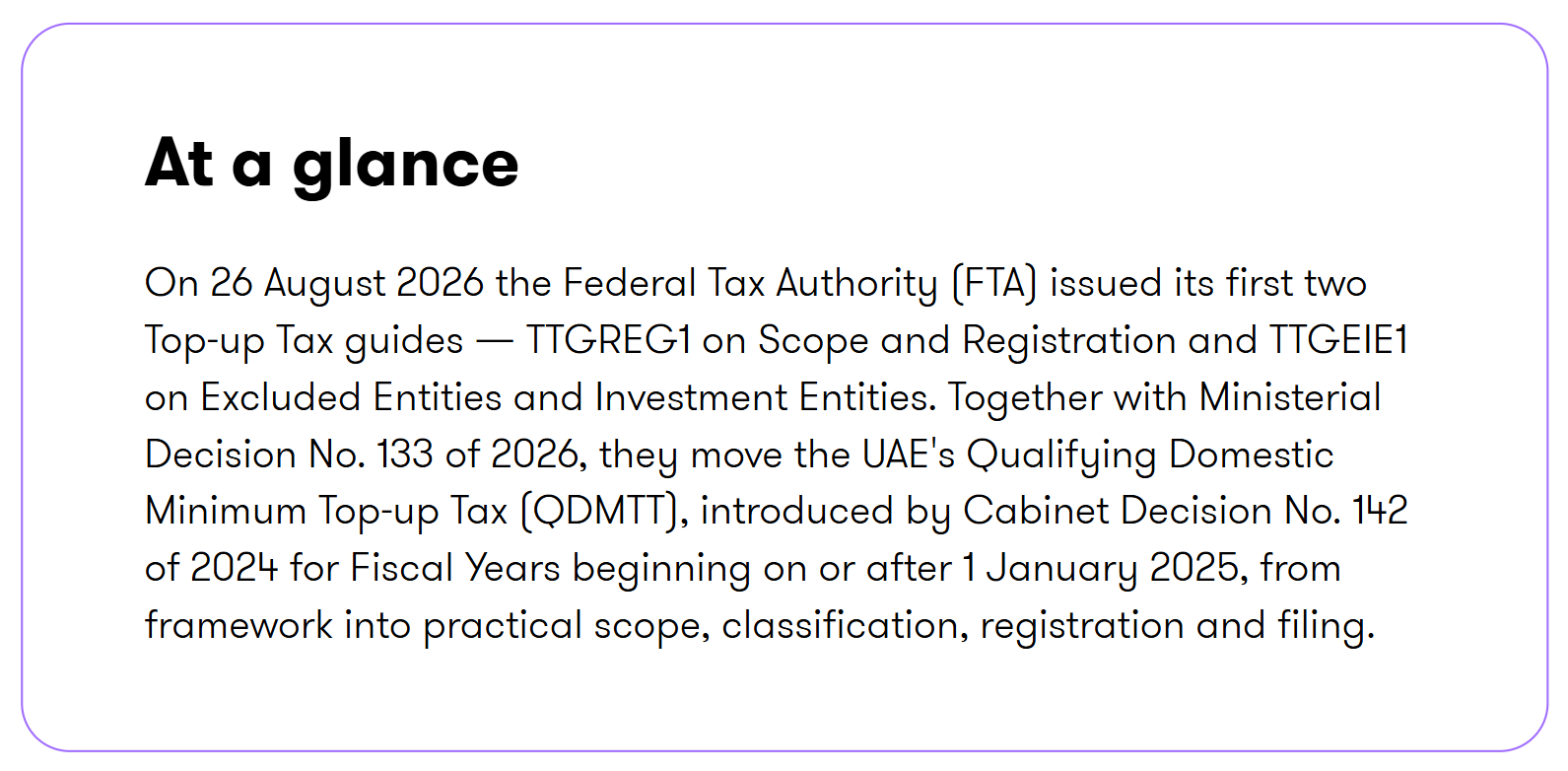
The UAE Ministry of Finance has issued Ministerial Decision No. 133 of 2026, clarifying which UAE entities are required to file a Pillar Two Information Return (P2IR) and when reliance can be placed on a filing made by a foreign Ultimate Parent Entity or Designated Filing Entity. The Decision aligns the UAE's Pillar Two framework with the OECD's centralised filing approach and provides greater certainty for in-scope multinational groups regarding local filing and notification obligations.
2. UAE FTA issues first detailed Pillar Two guidance — scope, registration and classification
A. What the guidance clarifies
Scope
- Scope follows the group's financial-accounting consolidation.
- Entities left out only because they are small, immaterial or held for sale still count;
- A standalone company with a foreign Permanent Establishment (PE) can itself form a Multinational Enterprise (MNE) Group; and
- The revenue of Excluded Entities counts toward the EUR 750 million threshold.
Sovereign Wealth Funds
Where a Sovereign Wealth Fund (SWF) qualifies as a Governmental Entity, it cannot be the Ultimate Parent Entity (UPE). The UPE role therefore passes down the chain, and a single structure may divide into several MNE Groups that are each tested separately.
Currency conversion
Non-euro amounts are converted using the average daily rates for the December before the Fiscal Year begins. The European Central Bank (ECB) rates are used first; the Central Bank of the UAE rates apply only where the ECB does not quote the currency, as is the case for the dirham. A year-end or annual-average rate can change the result.
Permanent Establishments
Several UAE branches carrying on the same business may be treated as one Permanent Establishment with a single registration, whereas branches carrying on different businesses are separate and each requires its own Tax Registration Number.
EmaraTax
Registration is completed on the entity's existing EmaraTax profile, and the first ten digits of the new Top-up Tax registration number match the existing tax number. Registration is still required even where the entity is exempt from Corporate Tax, is a Qualifying Free Zone Person, or expects no Top-up Tax to be payable.
Registration and filing
- Domestic Designated Filing Entity (DDFE). A single DDFE may register, file the Top-up Tax Return and pay the tax for the whole group — in particular for the Domestic Main Group (its ordinary Constituent Entities), a Domestic Minority-owned Subgroup, a Domestic JV Group and any Reverse Hybrid Entities. Once a DDFE is appointed, the other members do not register separately; entity-by-entity registration applies only where no DDFE is chosen.
- Designated Local Entity (DLE). A DLE may file the Pillar Two Information Return, also called the GloBE Information Return (GIR), with the FTA on behalf of UAE Constituent Entities, Joint Ventures and JV Subsidiaries.
- Designated Filing Entity (DFE) abroad. Where the Ultimate Parent Entity or a DFE files a conforming GIR abroad in a jurisdiction that has a Qualifying Competent Authority Agreement (QCAA) — the arrangement that allows the return to be exchanged with the UAE — in force for that year, no local GIR is required; the UAE entity must still notify the FTA of who filed and where.
Excluded Entities
Primary Excluded Entities:
- Governmental Entity;
- International Organisation;
- Non-profit Organisation;
- Pension Fund;
- an Investment Fund that is the Ultimate Parent Entity;
- a Real Estate Investment Vehicle that is the Ultimate Parent Entity.
Secondary Excluded Entities
Entities owned by primary Excluded Entities (other than a Pension Services Entity) that meet one of the following:
- At least 95% is owned by value (directly or through a chain of Excluded Entities), where the entity exists almost entirely to hold assets or invest funds for the primary Excluded Entities, and/or only carries out ancillary activities.
- At least 85% is owned by value (directly or through a chain), where substantially all of the entity's income is Excluded Dividends or Excluded Equity Gains or Losses that are left out of the Pillar Two income or loss.
B. Key things to do
- Confirm the group is a Multinational Enterprise Group — one operating in more than one jurisdiction with consolidated revenue of at least EUR 750 million in two of the four preceding Fiscal Years.
- Review the group for Excluded Entities and Sovereign Wealth Funds, which can take entities out of the charge or split the structure into separate groups.
- Map every entity and Permanent Establishment and classify each one, recording the definition relied on.
- Appoint the DDFE and register before 30 November 2026 (where the first in-scope Fiscal Year ends before 30 April 2026; otherwise within seven months of the year end).
- Appoint the entity that will file the GIR and file before the deadline — 15 months after the Fiscal Year end, extended to 18 months for the first year - to avoid the AED 10,000 penalty per entity (for point 4 and 5 above).
3. UAE FTA clarifies historical import VAT documentation under the reverse charge mechanism
A. What VATP045 clarifies
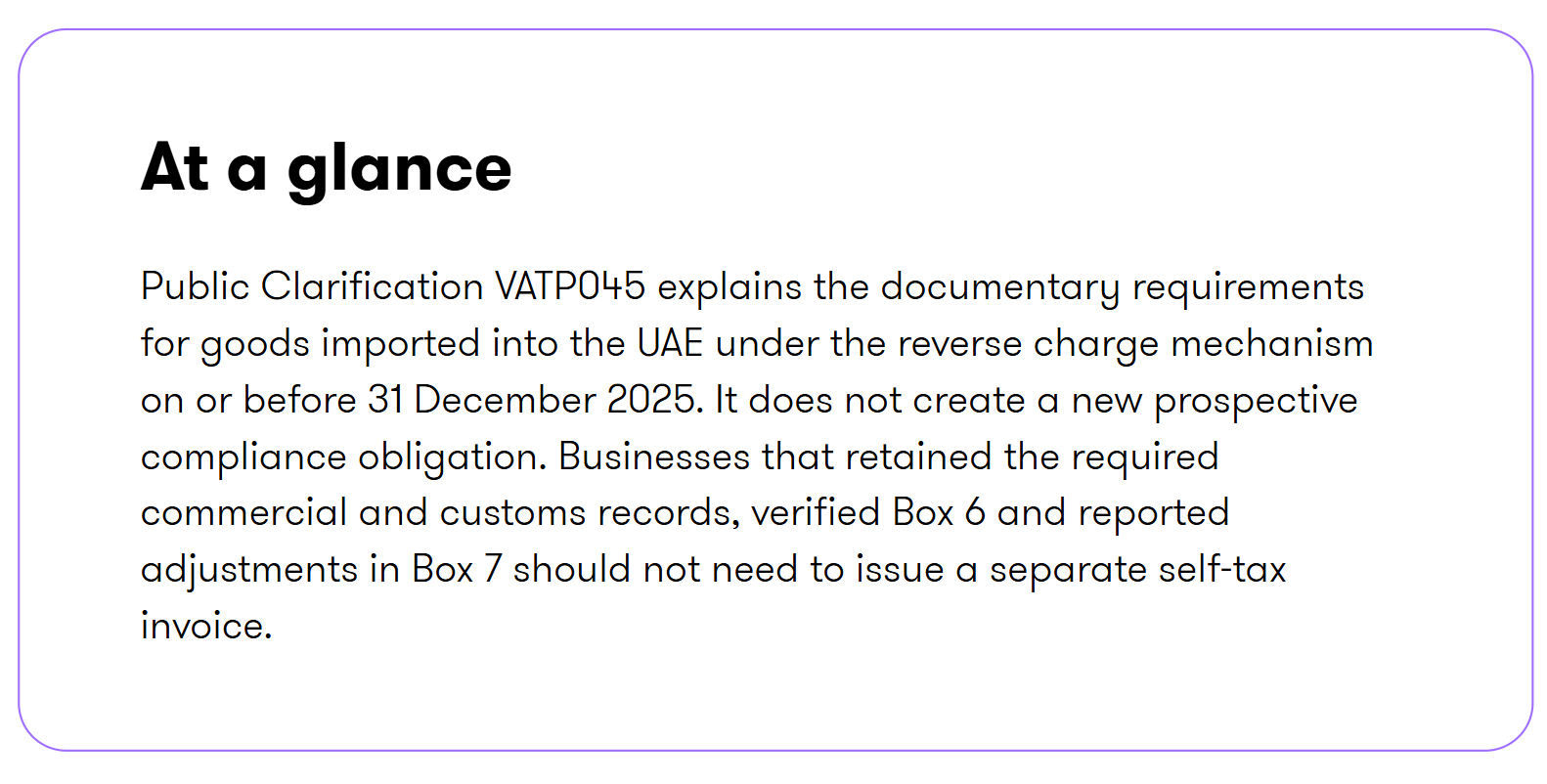
VATP045 applies to goods imported into the UAE under the reverse charge mechanism (Concerned Goods) on or before 31 December 2025. It clarifies the requirement to have self-tax invoice for the historical periods rather than introducing a new process going forward.
Why the self-tax invoice requirement existed
Under the reverse charge mechanism, the overseas supplier does not charge UAE VAT. The UAE importer is therefore required to account for the VAT under Reverse Charge Mechanism (‘RCM’). For historical imports, the self-tax invoice requirement was intended to create an internal tax document supporting this accounting treatment, where no UAE tax invoice was issued by the overseas supplier.
No separate self-tax invoice where appropriate records are maintained
A separate self-tax invoice should not be required where the importer has:
- Retained the overseas supplier invoice showing the description and value of the goods;
- Retained the relevant import records, including the customs declaration or bill of entry;
- Verified the import VAT amount pre-populated in Box 6 of the VAT return; and
- Reported any required adjustment in Box 7 of the VAT return.
Input VAT recovery
Import VAT may be recovered subject to the general input tax recovery conditions, including use of the goods to make taxable supplies and retention of the relevant supplier invoices, customs documents and supporting records.
B. What businesses should do now
- Review historical imports up to 31 December 2025 and confirm that overseas supplier invoices and customs records are complete.
- Reconcile customs import data to the amounts reported in Boxes 6 and 7 of the relevant VAT returns.
- Investigate and document any differences, missing records or unreported adjustments.
- Confirm that input VAT recovery is supported by the required documents and the normal recovery conditions.
- Avoid implementing a new self-invoicing process solely because of VATP045 where the prescribed records and return checks are already in place.
C. Position from 1 January 2026
Important: Following the amendment to the VAT Law, Taxable Persons are no longer required to issue Tax Invoices to themselves for Concerned Goods imported from 1 January 2026.
How Grant Thornton can help
Grant Thornton UAE can help businesses assess the impact of new tax regulations, identify potential exposures, and develop practical compliance strategies. Our tax specialists support organisations with Pillar Two readiness assessments, data and reporting requirements, effective tax rate calculations, governance frameworks, and ongoing compliance obligations.
Reach out to your Grant Thornton UAE tax contact for a focused walkthrough of how updates affect your business and a practical roadmap to implement them ahead of the effective dates.
This alert is intended for general information only and does not constitute tax, legal or accounting advice. The Decisions referenced are based on unofficial English translations; the official Arabic text prevails. Specific advice should be obtained based on the facts and circumstances of each business.