
Just 57% of private companies have adopted Generative AI, compared with 80% of public companies. According to Grant Thornton’s Digital Transformation Survey, which polled more than 550 executives on their technology adoption initiatives and plans.
While global surveys like this point to an adoption gap between private and public companies, the picture in the UAE looks different. With the UAE National Strategy for Artificial Intelligence 2031 shaping direction, many private companies here are moving quickly to adopt AI, specifically focusing on where automation delivers value in customer engagement, supply chain efficiency, and operational scaling.
A new reality for private companies
Private companies are struggling with a new reality, as customer strategies that worked in the past are no longer driving revenue. Customers now expect goods and services that are highly personalised, and many resource-constrained private companies haven’t invested in the Generative AI (GenAI) technology that enables customisation.
This gap puts private companies at a disadvantage as competitors use GenAI to enhance customer experiences and pursue new revenue opportunities. But the good news is that GenAI adoption doesn’t require a massive upfront investment or organisation-wide change management activities. A phased, practical approach to GenAI can deliver fast returns and build momentum for deeper technology enablement.
Our survey shows that despite trailing in GenAI adoption, private companies seem to understand the importance of tech, as they are slightly more likely to be increasing their technology spending this year than public companies. More than one-third (37%) of private companies plan to increase their technology spending by at least 11% this year, compared with 23% of public companies.
The impetus for change is real. Fortunately, private companies can put that enthusiasm to work quickly. With small, focused use cases, it’s possible to make incremental investments in GenAI and generate quick wins that fund larger projects.
"In the UAE, private companies increasingly treat AI as a competitive lever, not a distant ambition. The leaders gaining traction are those aligning AI investment with clear business outcomes and the country's national digital priorities."
Marwan Galal, Director, Technology Advisory at Grant Thornton UAE
From GenAI to growth: A smart path for private companies
GenAI initiatives for private companies can start with simple approaches. Rather than launching broad AI programmes, many of the UAE businesses making progress are prioritising focused pilots that deliver measurable impact within three to six months, then scaling what works.
Our survey shows that two of the most common uses for GenAI are data analytics/business intelligence and customer relationship management. Data analytics and business intelligence use cases can include:
- Summarising sales dashboards or financial reports for stakeholders across a multi-emirate or regional operation
- Forecasting demand for a retail or hospitality business ahead of peak periods such as Ramadan, Eid or the winter tourism season
- Analysing customer feedback in both Arabic and English to pinpoint where service can improve
For customer-facing purposes, many companies are using GenAI to:
- Run multilingual chatbots that answer FAQs and track orders
- Generate invoices, reports and VAT-ready documentation from standard templates
- Handle appointment reminders and follow-up messages across WhatsApp and other channels widely used across the region
The easiest way to begin GenAI adoption is by identifying business processes and problems and considering how (and whether) GenAI can help. The best targets are processes that are highly repetitive, follow clear rules or patterns, and require a lot of human time to perform but little human time to verify.
Data entry, invoice processing, customer support, contract review, document generation, and inventory monitoring and management are common use cases that can be addressed with GenAI, provided the data supporting those tasks is accurate, complete, timely and consistent.
A use case that meets those criteria and aligns with the organisation’s business strategy is often the best place to start. The potential return on investment should be validated with a pilot or proof-of-concept before proceeding with full adoption.
As success is achieved and momentum for GenAI improvements increases, a structured approach can be implemented to prioritise use cases and funding for additional initiatives.
Sameer Abdi, Partner and Head of Advisory at Grant Thornton UAE, sees the strongest returns where the technology is built into everyday operations rather than run as a side project.
"GenAI is most effective when it is embedded directly into how teams already operate, whether in finance, procurement or customer engagement. The objective isn't experimentation for its own sake; it's intelligent execution that improves margins."
Sameer Abdi, Partner and Head of Advisory at Grant Thornton UAE
Tech enablement starts with team enablement
The benefits associated with AI will only be realised by private companies whose leaders have the courage and compassion to implement the change effectively.
Courage is necessary because almost every business change encounters resistance. Leaders need to be prepared to push through that resistance to implement technology that’s going to improve their business.
Compassion is necessary because employees might be afraid that GenAI is going to replace their jobs. Answering their concerns requires consistent, transparent communication, as well as training to help them use the technology, and identify new GenAI use cases that will make them more effective and confident in their roles.
“The challenge with AI adoption is rarely technology availability; the tools already exist. Success depends on whether organisations can create awareness, build capability, reinforce new behaviours and inspire confidence in the change,” says Kabir Dhawan, Partner, Strategy and Transformation, Grant Thornton UAE.
He adds: “In our experience, AI transformation is fundamentally a people challenge, which is why a structured change strategy is often the difference between isolated pilots and enterprise-wide value creation.”
The best employee GenAI training includes:
- Aligning training goals with business outcomes
- Explaining the tenets of ethical and responsible AI use
- Undertaking a skills gap assessment to tailor training to employees’ needs
- Setting measurable learning outcomes for use of AI tools
- Providing hands-on experience, as many users learn through active use
- Creating opportunities for continuous learning
This training is the foundation for the courage and compassion that will help leaders build a culture that nurtures innovation and value creation at a time when private companies need it most.
Governance cannot be an afterthought
As adoption grows, data protection, AI governance, cybersecurity and risk management need to be built in from day one rather than added in later. Clarity around data handling, privacy compliance and model oversight reduces risk and gives customers, regulators and investors greater confidence in how the technology is used. This matters particularly in the UAE, where the Personal Data Protection Law sets out how organisations must collect, store and process personal data.
"AI adoption has to balance innovation with governance. Companies that build strong control environments around data usage and model oversight will scale faster and more sustainably."
Anand Balasubramanian, Partner and Head of Risk and Compliance Advisory at Grant Thornton UAE
Four tips for making tech investments count
Private company leaders have limited funds to spend on GenAI, so they need to make those investments count.
“Incorporating AI into tech enablement is a balancing act that pays off when leadership, governance and value creation move in sync,” said Mike Notarangelo, Partner and Private Equity Audit Leader for Grant Thornton.
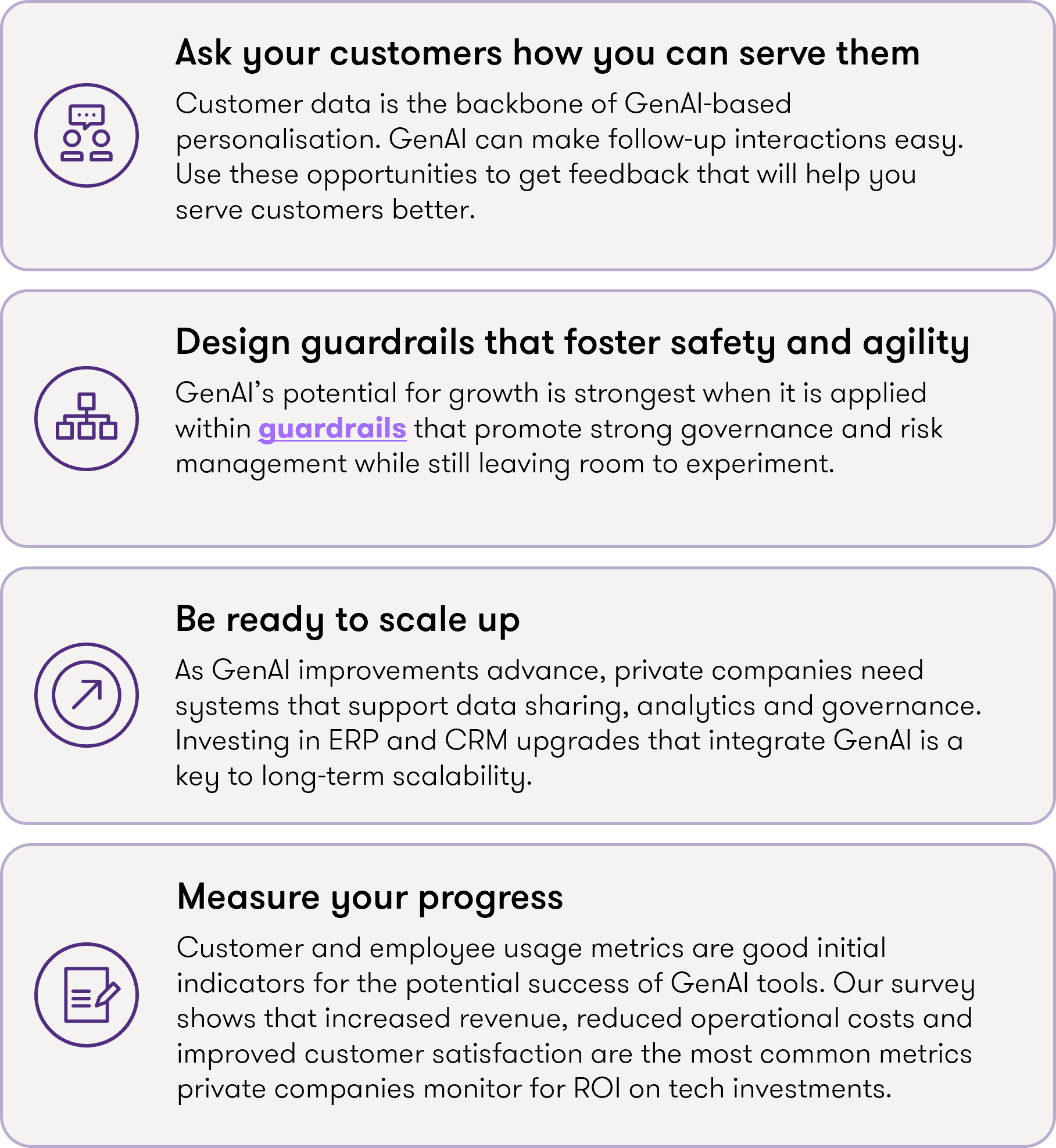
To get the most return out of GenAI spending, private company leaders should consider the following:
Build for long-term growth
Private companies can’t afford to wait on Generative AI. The risks of inaction, from lost market share to weaker customer engagement, are too high.
But the path forward doesn’t have to be disruptive. A step-by-step approach focused on return on investment allows private companies to adopt GenAI now while building the foundations needed to scale as they grow. The tools and opportunities are already in place. What low-risk, high-impact GenAI use cases could help your business create value today while positioning it for future growth?