
The role of the Chief Risk Officer (CRO) is undergoing a fundamental shift. Once positioned primarily as a compliance and control function, today’s CRO is increasingly expected to operate as a strategic partner, integrating risk into decision-making, supporting growth, and shaping institutional direction.
This shift is being driven by regulatory pressure, technological disruption, and a risk landscape that has grown significantly more complex. Advances in AI are accelerating this change, enabling CROs to move from retrospective oversight to real-time, forward-looking decision support — extending the function's influence beyond control into execution and strategy.
At the same time, the growing use of AI introduces its own governance demands. As these tools become embedded across the risk lifecycle, strong oversight is essential to ensure innovation is introduced safely and within clear control boundaries. Without that discipline, the same technologies that are designed to improve decision-making can just as easily amplify risk.
Historically, the CRO operated as a “second-line gatekeeper,” focused on regulatory submissions, capital ratios, and control frameworks. Today, the role has expanded into a strategic partnership with executive leadership. That expansion is reshaping how the function is structured, resourced, and measured.
Evolving role of the CRO
Modern CROs are no longer measured solely on regulatory outcomes. Their mandate now includes:
- Risk translation: Converting risk into decision-relevant metrics linked to capital, earnings, and liquidity
- Strategy integration: Embedding risk into strategic initiatives, including digital transformation, M&A, and product development
- Independent challenge: Ensuring strategy remains executable within the institution’s risk capacity
- Governance elevation: Reporting directly to the CEO or Board Risk Committee, strengthening independence and influence
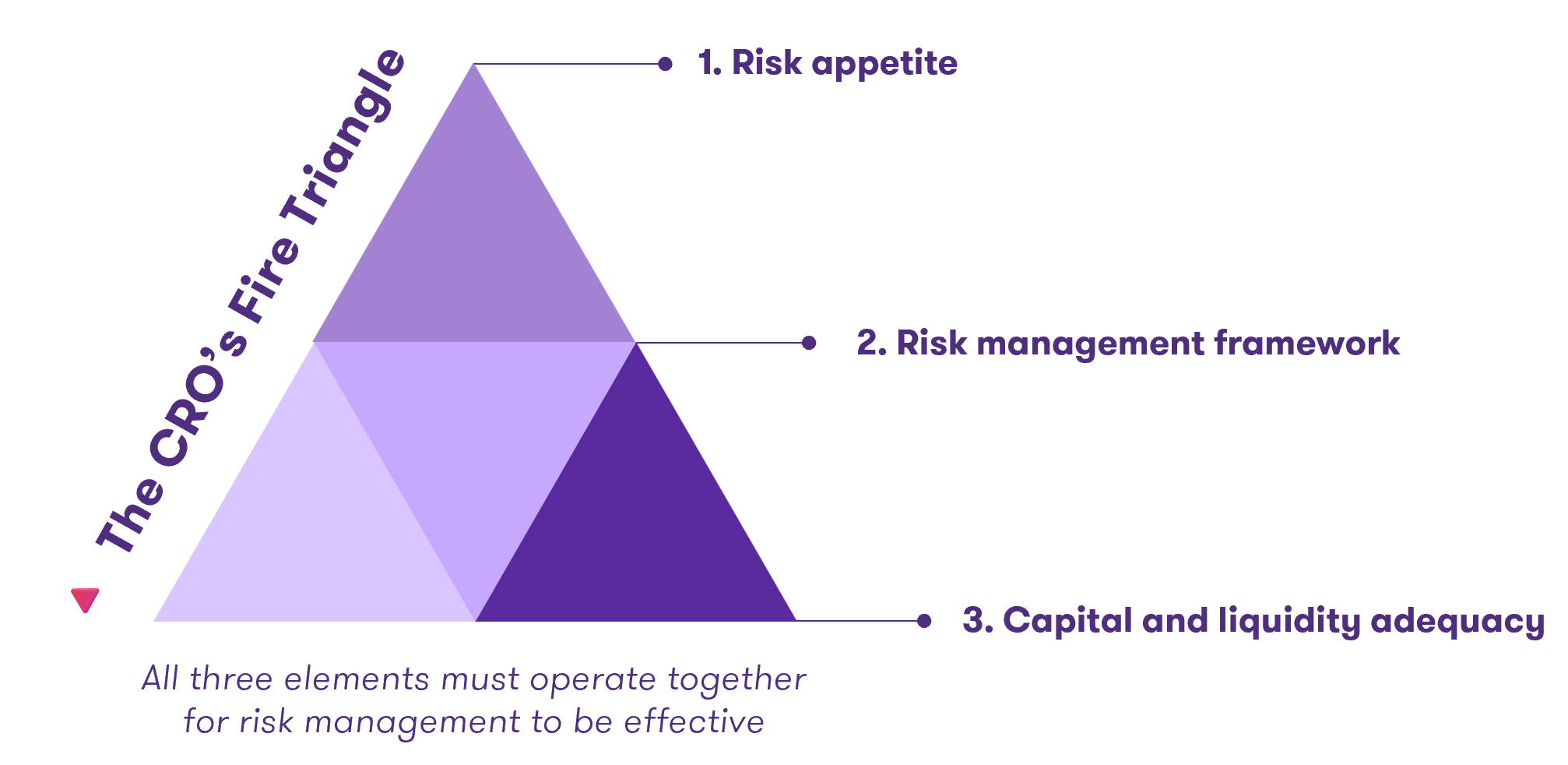
At the core of this role is the integration of three interdependent pillars:
- Risk appetite: Defining risk-return trade-offs aligned with strategy
- Risk management framework: Embedding policies, systems, and governance
- Capital and liquidity adequacy: Ensuring resilience through ICAAP, ILAAP, and stress testing
Effective CROs translate strategy into clear risk appetite metrics and limits, embedding risk directly into decision-making rather than applying control retrospectively. This enables faster, more confident decisions within defined boundaries.
Growth enabler, not growth constraint
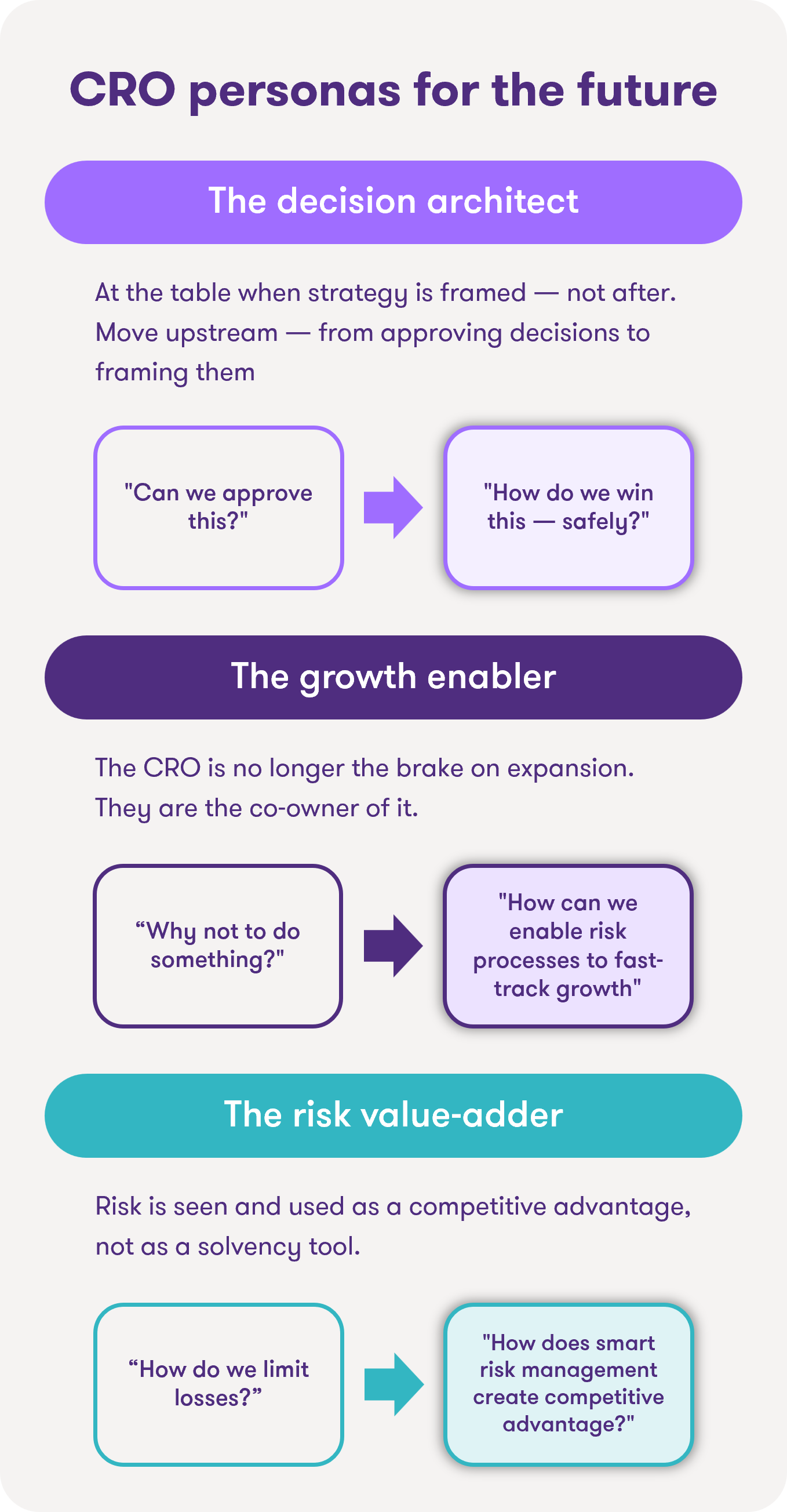
In growth-oriented markets such as the GCC, this shift is particularly pronounced. CROs are expected to support risk pricing in complex transactions, engage early in deal structuring and portfolio strategy, and enable faster decision-making.
In practice, this means the CRO is moving upstream — from approving decisions to helping frame them. The question shifts from “Can we approve this?” to “How do we execute this safely and profitably?”
A more complex risk landscape
The CRO mandate is expanding in response to several structural forces:
- Rising non-financial risks (cyber, fraud, third-party risk exposure)
- Heightened geopolitical uncertainty
- More principles-based regulation
- Growing integration of climate risk and ESG into credit and capital planning
Managing this breadth requires commercial fluency, regulatory depth, and digital capability in equal measure. Delivering on this expanded mandate requires a corresponding shift in how technology and AI are embedded within the risk function.
Technology and AI: the catalyst for transformation
Technology, particularly AI, is increasingly central to how risk is identified, measured, and managed. Legacy risk models no longer work; traditional approaches built on manual processes, siloed data, and periodic reporting are difficult to sustain at scale. As institutions grow and regulatory expectations intensify:
- Data volumes continue to grow significantly
- Decision cycles are compressing
- Risk functions are under pressure to keep pace with innovation and product complexity
In this context, technology becomes core decision infrastructure.
What do organisations really focus on with AI?
- Strategy: Deciding where AI should (and should not) be used
- Execution: Concrete AI use cases
- Governance: Making AI safe, compliant and trustworthy
- Literacy and L&D: Understanding what AI really does
For risk leaders, the AI conversation has already moved on. Now, organisations are thinking about whether their controls, governance and literacy are evolving fast enough to keep pace.
From point solutions to integrated risk architecture
As risk functions scale, institutions are moving from fragmented tools to integrated, enterprise-wide architectures that enhance data consistency and enable real-time risk visibility. Those investing in this shift are typically focused on:
- Unified risk data platforms
- Integrated stress testing and scenario modelling
- AI-enabled GRC systems
- Real-time risk monitoring
Together, these capabilities enable CROs to shift from retrospective reporting to forward-looking, scenario-based decision support that operates at the pace the business requires.
AI across the risk lifecycle
AI is transforming risk management across three dimensions:
- Identify: Detecting emerging risks using large, unstructured datasets
- Measure: Enhancing modelling of financial and non-financial risks
- Monitor: Enabling real-time oversight and automated controls
The most mature institutions are moving beyond isolated use cases towards enterprise-wide integration, although most remain in transition.
Governance: the CRO’s defining challenge
As AI adoption increases, so do the risks. Robust governance is required to manage:
- Model opacity and explainability
- Algorithmic bias and fairness
- Data quality and lineage
- Model drift in dynamic environments
Regulators in the UAE and across the GCC are setting increasingly clear expectations — AI accountability sits with the CRO and the board. This requires establishing model inventories, defining AI risk appetite (including thresholds for bias, explainability, and automation), and embedding independent validation and human oversight.
The CRO’s role is to make AI safe to scale, maintaining control without constraining progress.
From efficiency to strategic advantage
As AI adoption matures, its role is shifting from efficiency gains to enabling better decision-making and strategic agility. Key use cases include:
- Real-time fraud detection
- Automated regulatory reporting
- More granular risk insights for leadership
The long-term value of AI in risk lies in improving the speed and quality of decisions — giving institutions the confidence to act faster within clearly defined boundaries.
From awareness to execution
The trajectory is clear: the CRO function is becoming more strategic, technology-driven, and central to performance. Yet many institutions remain in transition, particularly in AI governance, integrated risk architecture, and real-time analytics.
Key questions for CROs include:
- Is risk appetite embedded in strategic decisions?
- Can your technology support real-time, enterprise-wide risk visibility?
- Do you have the governance and capability to scale AI safely?
Institutions that address these questions now will be better positioned to use risk as a source of strategic advantage. Those that delay will find it harder to close the gap, as expectations from regulators, boards, and markets continue to rise.
The path forward
If you are reassessing your CRO operating model, risk technology stack, or AI governance framework, we would welcome the opportunity to share practical insights and tested approaches from across the GCC and wider international markets.